Book Review: Babel by R.F. Kuang
by Malte Skarupke
The book Babel, or The Necessity of Violence: An Arcane History of the Oxford Translators’ Revolution is fascinating. And I’m not sure how much of this the author intended. It’s mainly fascinating because it’s trying to discuss colonialism, technological progress, and inequality with characters who are all stuck in the 19th century and are unable to reason with history in mind. And throughout the entire book the author acts like this is the right way of thinking. This review will contain major spoilers, partially because I don’t think the book is actually worth reading. I found it very frustrating and nearly stopped a few times.
The main reason for this frustration is that the “good guys” are often quite evil and get nearly everything wrong all the time and don’t achieve any of their goals. There are very few actual good people in this book, and those actual good people get treated badly by the story. The “good guys” think that the actual good people are evil.
The story is about a kind of magic (“silver working”) where you can use a bar of silver for direct effects (heal someone from cholera, kill someone) or imbue the silver with a kind of aura that affects things near it. So you can embed the right bar of silver in e.g. a steam engine and the engine runs more efficiently. Or you can embed it in a buildings foundation to make the building stronger. The magic spells require fluency in multiple languages, so being a translator is a very prestigious job. The story takes place at the University of Oxford in the 1830s, where silver working has recently gone through its own industrial revolution (at the same time as the actual industrial revolution is going on) so that these aura effects have been scaled up, creating enormous benefits for society, and enormous wealth for the people in charge.
Colonialist Imperialism vs Anarchism
The book is mainly about how this technological progress changes the world. But the two main parties are
- The bad guys: British colonizers who would like nothing more than to take over the world and exploit all other countries. These are racist warmongering assholes who believe in a zero-sum world where they have to win, and if others lose in the process, that’s just how the world is. (oh and they’re also academics, which is the first slight disconnect)
- The “good guys”: Modern day Robin Hoods who steal from the university so that the poor can also benefit from silver working. It’s hard to characterize them because they don’t have a fully coherent plan, but they’re probably closest to anarchists. These people play negative-sum games (theft, sabotage) mostly because they’re upset that the first group got so rich while being assholes, and also because they enjoy helping the poor directly.
The obvious issue, knowing how the industrial revolution turned out, is that both of these mindsets are deeply stupid. Progress is a positive-sum game. We now live in a world that’s vastly better than the 1830s, with much of the world lifted out of poverty. The bad guys are working towards that much better world, but they’re doing it for selfish reasons and they incorrectly believe that they have to hurt others to get the benefits that they’re getting. Meanwhile the “good guys” are acting in a way that will delay the better world that we now live in. They have good intentions and the book constantly acts like that is what counts, but it is intensely frustrating to read. It’s never quite clear what their plan is. They talk about helping the poor, though that topic stays abstract, and about sabotaging the bad guys, which they get very specific on.
A Trumpian Mindset And the Tragedy It Leads To
When talking to my wife about this, she pointed out that many people still think in the zero-sum mindset today. In my mind the most obvious person is Donald Trump, and maybe the people who vote for him. So the book is extra fascinating because it has these people who think like Donald Trump, but who would probably hate him. If a left-leaning person had the same world view as Donald Trump, they might turn out like the “good guys” in this book.
The saddest character in the book is Letty, the main actual good person. Obviously the “good guys” end up hating her by the end. She is the only one who seems capable of breaking out of the Trumpian world view. She survives until the end of the book and the main hope is that she manages to improve the world. Her tragedy is that she falls in love with Ramy, one of the “good guys” who is an immigrant from India. But Ramy refuses her advances because of this same weird dynamic where he has fully adopted the racist colonial world view where a brown Indian man can’t date a white English lady. Letty is realistic about this and is willing to try to transgress the norms of the time and find out what the consequences are, but once again the “good guys” accept the world view of the bad guys and are unable to get over it.
The entire time while reading the book I’m not sure what the author actually thinks. Does she have this Trumpian mindset? The first chapter quotes from Adam Smith’s The Wealth of Nations, which makes you think that the book will explore the economic impacts of this silver working. But then everyone is acting very stupidly about it, from an economist point of view (but consistent with 19th century beliefs). Similarly the author writes a chapter which perfectly explains Letty: A brilliant girl from an upper class English family who was constantly oppressed because of the sexism of the time. But her genius and hard work allow her to escape her path and go to university. When the “good guys” join the anarchist group she has her doubts, but joins in because she was also oppressed and is trying to improve the world. She quits and betrays them when it’s clear that the anarchists are turning towards violent means. She is very clear-eyed and sane about all of this. So once again it’s very interesting how the author can write this character, but also writes all the other characters who think Letty is evil.
At one point, when the existence of the anarchist group is first revealed to Letty, she makes all kinds of sane suggestions about how the world could be improved using their skills for magic, including finishing school then going into philanthropy. This actually would make sense, but the author criticizes the idea in a footnote. The author can write both sides, but then she always gives the last word to a Trumpian mindset where philanthropy is suspect.
The Necessity of Violence
The confusion about the author’s intent peaks at the end of the book when things turn violent. The anarchist group occupies Babel, the home of most silver-working in the country, by shooting its leader and making everyone else flee, and goes on strike. The goal is to weaken the British empire with the most destructive sabotage. The magical auras from silver keep many things working in the country and they can disrupt it all.
At some point earlier in the book it’s revealed that the translators’ guild (the “bad guys”) is deeply irresponsible about how they run their business. They intentionally make it so that silver has to be regularly maintained because that makes them more money. Also it’s revealed that they only have two translators in all of England who are fluent enough in English and Chinese to keep the silver bars working that rely on those two languages. One of them dies in the story, the other joins the strike, so magic auras all over the country start failing very quickly. It’s incredible irresponsible that such important technology relies on just two people. (once again the book is internally confused because in the book all of this is treated as sane and is not even questioned)
Silver afforded London all of its modern conveniences. Silver powered the ice-making machines in the kitchens of London’s rich. Silver powered the engines of the breweries which supplied London’s pubs, and the mills which produced London’s flour. Without silver, the locomotives would cease to run. No new railways could be built. The water would run foul; the air would thicken with grime. When all the machines that mechanized the processes of spinning, weaving, carding, and roving ground to a halt, Britain’s textile industry would wholly collapse. The entire country faced possible starvation, for there was silver in the plough-frames, seed drills, threshing machines, and draining pipes throughout Britain’s countryside.
(Page 485)
The strike fails terribly because, oh shock, it mostly hurts poor people. Turns out silver working was benefiting the whole society, not just the rich. (just like the real industrial revolution) This quickly opens up a rift in the anarchist group. Some realize that they’re mostly hurting the poor and want to stand down, or at least still maintain some of the silver bars. But after a vote they decide to keep the strike going on full so that the pain can even be felt by the rich people who they’re striking against. Dozens of people die as a result from traffic accidents from malfunctioning carriages and crumbling buildings which were held up by magic auras. (the buildings crumble the day after the scheduled maintenance. Who schedules the maintenance on the last possible day? Again incredibly irresponsible) Eventually it’s revealed that the rich, who were the target of this strike, were barely affected. And when the rich did finally lose their patience, they stopped being polite and send in the army for real. The anarchists cave in immediately. Part of the group flees, but the others stay behind to end the book in a giant suicide bombing, destroying the silver-working center of the country with its library, throwing back technological progress by a decade or more.
Once again the author’s world view is deeply confusing because she writes as if these people are heroes, but she also writes that they’re just causing a giant disaster without achieving any of their goals. It surely must be a commentary on how the “necessity of violence” is bullshit and leads to far more suffering and doesn’t help in the end. But it has that same fascinating confusion as the rest of the book where the author pretends that these are heroes.
What Does the Author Think?
I am writing this without having looked up R.F. Kuang. I have not read any other book by her. I think it’s more interesting to have this uncertainty. Currently my odds are
- 30% chance that she has this Trumpian mindset
- 60% chance that she is confused and this book is her way of working through her confusion, with the result being that she is still trying to hold on to this zero-sum world view, but she also sees that it doesn’t really work
- 10% chance that she understands all of the issues in the book and wrote it as a brilliant criticism of the anarchist branch of the American far left by showing how their world view is stuck in the past and doesn’t work
Given that I put the biggest odds at “she is working through her confusion” and that I think she didn’t finish working it out by the end of the book, the rest of this blog post will be me trying to talk about how to move on from this confused mindset.
Technological Progress in the Trumpian World View
This is obviously relevant right now because Trump started a war with Iran, and when they responded with blocking the Strait of Hormuz, causing economic problems and fuel shortages all over the world, mostly affecting poorer countries, Trump responded with joining in and blocking all oil trade from Iran. Meaning now Trump and Iran are blocking the Strait of Hormuz together. It’s exactly the kind of thing that the “good guys” in Babel would be doing. Sabotaging the world in order to hurt their evil enemies (and there’s no doubt that the Iranian regime is evil) but doing it in such a way that they’re mostly hurting the poor. (This is just the current example. If I had written this review six months earlier or later, I’m sure I could have named another current example)
The other reason why it’s relevant is that we are going through the AI revolution. As a programmer I am obviously very positive about technological progress. The book is very negative on it and often gives voice to Luddites and focuses on how people lost their livelihoods as the factories automated. I’m sure that was very bad at the time, but with the benefit of hindsight we know that this turned out great. New jobs popped up, including mine, programming. We now live in a country with 100k massage therapists, and even more people whose job it is to care for pets. We live longer lives because more people could dedicate their lives to curing diseases. Average people now live healthier lives, eat better food, and enjoy better entertainment than kings and queens of the 19th century. If the anarchists in the book had their way, this would either not have happened or would have happened much more slowly. The most sensible method of dealing with the terrible colonial imperialists in the book would have been to finish school at Babel, and to then open a competing school with the goal of democratizing silver-work. Yet the only person who even vaguely gestures in this direction is the evil Professor Lovell, when he points out that other countries have been unable to open competing institutions. (mainly because they have bad governments) In particular some of the anarchist group have been in a position for years to do this, but have not done it, preferring to work in secret so they can sabotage the bad guys.
I’m sure that as a programmer I have reduced the number of jobs required to finish a project. Most obviously when I was a tools programmer on Just Cause 3. If it hadn’t been for my work (or somebody else in the same role) that game would have required more artists and more designers. But obviously those people wouldn’t have been hired. The budget wasn’t there. Instead the game would have just turned out worse. Similarly right now AI is automating a lot of programming tasks. It’s clear that this will end differently once AI can do all tasks (also called “AGI”) but so far my job is secure and I have been using AI to create new projects that I couldn’t have done on my own before. (1, 2) Maybe in another world I would have hired a web designer or frontend programmer to do the things that I couldn’t do myself, but realistically I wouldn’t have. Either the projects would have turned out worse or just wouldn’t have gotten done at all.
So when the book talks about people being out of jobs because looms are being automated, I just can’t empathize. In my mind automating looms is a great thing. That’s what I do for a living. It allows people to get more stuff done or to do better work. If you’re against that automation you’re probably destroying the 100k massage therapist jobs in the country because those wouldn’t have existed in a world in which people make clothing by hand. There just wasn’t enough wealth in the 1830s. But in a Trumpian world view these things are zero-sum and if someone gets rich off of automatic looms, that must mean that others are poorer as a result. Now we know that this is a silly thought, but people didn’t know in the 19th century.
The Lecture
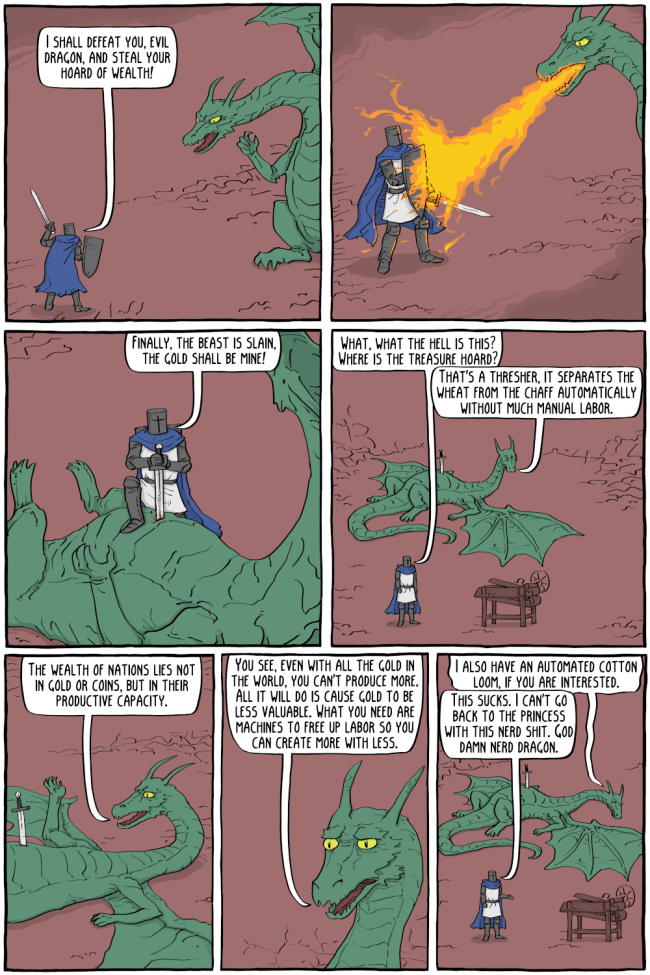
There is a part in the book where one of the professors becomes disillusioned with their work. I’m going to quote a long section to show you how the book talks about these things:
The silver industrial revolution had decimated both the textile and agricultural industries. The papers ran piece after piece exposing the horrific working conditions inside silver-powered factories (although these had their rebuttals, including one refutation by Andrew Ure, who argued that factory workers would feel a good deal better if they only consumed less gin and tobacco). In 1833 the surgeon Peter Gaskell had published a thoroughly researched manuscript entitled The Manufacturing Population of England, focusing chiefly on the moral, social, and physical toll of silver-working machinery on British labourers. It had gone largely unheeded at the time, except by the Radicals, who were known to exaggerate everything. Now, the antiwar papers ran excerpts from it every day, reporting in grisly detail the coal dust inhaled by small children forced to wriggle into tunnels that adults could not, the fingers and toes lost to silver-powered machines working at inhuman speeds, the girls who’d been strangled by their own hair caught in whirring spindles and looms.
The Spectator printed a cartoon illustration of emaciated children being crushed to death under the wheels of some nebulous contraption, which they captured WHITE SLAVES OF THE SILVER REVOLUTION. In the tower, they laughed themselves silly over this comparison, but the general public seemed genuinely horrified. Someone asked a member of the House of Lords why he supported exploiting children in factories; he replied quite flippantly that employing children under the age of nine had been outlawed in 1833, which led to more general outcry over the suffering of ten- and eleven-year-olds in the country.
‘Is it really as bad as all that?’ Robin asked Abel. ‘The factories, I mean.’
‘Worse,’ said Abel. ‘Those are just the freak accidents they’re reporting on. But they don’t say what it’s like to work day after day on those cramped floors. Rising before dawn and working until nine with few breaks in between. And those are the conditions we covet. The jobs we wish we could get back. I imagine they don’t make work half as hard at university, do they?’
‘No,’ said Robin, feeling embarrassed. ‘They don’t.’
The Spectator story seemed to greatly affect Professor Craft in particular. Robin found her sitting with it at the tea table, red in the eyes, long after the others had finished their breakfast. She hastily wiped her eyes with a handkerchief when she saw him approach.
He sat down beside her. ‘Are you all right, Professor?’
‘Oh, yes.’ She cleared her throat, paused, then nudged the paper. ‘It’s just… it’s a side of the story we don’t often think about, isn’t it?’
‘I think we all got good at choosing not to think about certain things.’
She seemed not to hear him. She stared out of the window at the green below, where the strikers’ protest grounds had been turned into what looked like a military camp. ‘My first patented match-pair improved the efficiency of equipment at a min in Tyneshire,’ she said. ‘It kept coal-laden trolleys firmly on their tracks. The mine owners were so impressed they invited me up for a visit, and of course I went; I was so excited about contributing something to the country. I remember being shocked at all the little children in the pits. When I asked, the miners said that they were completely safe, and that helping out in the mines kept them from trouble when their parents were at work.’
She took a shaky breath. ‘Later they told me that the silver-work made the trolleys impossible to move off the tracks, even when there were people in the way. There was an accident. One little boy lost both his legs. They stopped using the match-pair when they couldn’t figure out a workaround, but I didn’t give it a second thought. By then I’d received my fellowship. I had a professorship in sight, and I’d moved on to other, bigger projects. I didn’t think about it. I simply didn’t think about it, for years, and years and years.’
She turned back towards him. Her eyes were wet. ‘Only it builds up, doesn’t it? It doesn’t just disappear. And one day you start prodding at what you’ve suppressed. And it’s a mass of black rot, and it’s endless, horrifying, and you can’t look away.’
(Pages 492 to 494)
(a “match-pair” is the magic spell you can cast on silver, it’s a pair of words from different languages)
So what do you do with that? It’s really bad. Your magic spell made a kid lose both legs because a mine cart couldn’t be stopped. But in a sense it’s the wrong thing to focus on. The important thing to notice that this is better. Working conditions were terrible before, now they’re slightly less terrible. Obviously it’s not better for the kid who lost both legs, but given the nature of the invention it’s likely that risk of injuries went down on average. Less risk of mine carts derailing and injuring people, more risk of getting hit by a mine cart if you’re on the tracks, which adds up to less risk overall. The professor is making the mistake of not giving herself credit for the accidents that didn’t happen. We know, with the benefit of hindsight, that piling up inventions leads to a much better life. You’d rather be working in a English coal mine the 2000s than in the 1830s, because working conditions became much better. Partially due to labor organizing and demanding better working conditions, but mostly due to technology getting better. (no amount of labor organizing in the 1830s would have improved conditions to the level of the 2000s) And in fact the last big coal mine in England shut down in 2013, which would have never happened if it weren’t for better technology. So when you’re presented with a terrible situation it would be great if you could solve it, but if you can’t, maybe you can make it better, and that’s a good thing to do. And then eventually the new invention was retired, maybe in favor of a new, even better magic spell, maybe for nothing at all. This is fine. Trying is progress as long as you sometimes come up with things that stick. It’s not necessarily a straight line.
Obviously nothing is better along every single dimension. For almost every invention you can find some aspect where it’s worse. That’s just the messiness of life, it happens with most decisions you have to make, not just new inventions. But notice that there can be decisions that are better for almost every involved party. This invention is better for the mine owners and the mine workers (assuming less risk of injury on average) and it’s also better for the professor. The increased reliability is so much better that all three involved parties benefit. In a Trumpian world view you’d think that this is impossible. In a Trumpian world view you think that if one person benefits, another must lose out. (the book is reliably cynical about improvements to the world, like abolition of slavery, or making child labor illegal for kids under the age of nine, see above. It always finds something to complain about and ignores that things got better) That’s where the cartoon above comes in. The thresher and the automatic loom made life better for the majority of people. Not everyone, but for most (I’m sure someone was unable to find a new job, but employment in the English textile industry went up, not down, peaking in the early 20th century).
This point can be made more obviously in the other direction: There are some acts that just make things worse. Like if I go around littering, or smashing windows, that just makes things worse for everyone. (except maybe briefly myself because littering or smashing windows is slightly more fun than not littering and not smashing windows, but in the long term it also makes things worse for myself) I’m just causing people to have costs to bring things back into order, and those costs bring us no benefits except getting us back to the status quo. So if there are acts that can be worse for almost everyone, where there is no winner for the loser, maybe that makes it believable that there can also be acts that can be better for almost everyone. Like building an automatic loom. It’s the difference between negative-sum games (littering), zero-sum games (land disputes), and positive-sum games (improving technology).
If you want to be really rich, then for most of human history you had to take from someone else. The richest people had to field armies to conquer neighboring countries and to force the conquered to pay taxes. This stopped being true. Now the richest people are entrepreneurs and merchants. And even normal people lead better lives than conquerors of the past. This is because positive-sum games make the world so much better. There is no amount of conquering and taxing you can do in the middle ages that would allow you to lead as good of a life as billions of people have today. (measured in things like health, food, entertainment, …) And those billions of people don’t constantly have to defend their wealth against usurpers and competing powers. The only way to get to that broad wealth is with positive-sum games like trade and technology.
The long take to watch is the Sarah Paine interview where she talks about “Continental Powers” vs “Maritime Powers”. Excerpt here, but also watch the full thing:
The Unpleasant Parts of the Book
So back to the book. It makes sense that if you, as an author, want to talk about these things, you should set your story in the 19th century because back then these were real problems. Nowadays globalization and automation is lifting the world out of poverty one country at a time and this is great. Back then this was very much not the case. Colonialism was exploiting and destroying countries. But from today’s perspective it’s just so frustrating to read the opinions of people who had 19th century frameworks and didn’t know how to solve this and then go about doing lots of bad things because their world view is so uninformed. Is that plausible? Yes. Is it fun to read as a 21st century person? No.
The other part where I had to skip pages was that at some point in the book the “good guys” have to cover up a murder. The book makes this very unpleasant. They’re stuck on a boat and have to somehow come up with a cover story to hide the murdered until the boat lands. This leads to high tension for weeks. When they finally land, you think it’s over now, but no, now they meet the neighbor of the murdered person and so the tension is high for longer. After that’s over they have to face the housekeeper and then coworkers and after I’ve had too much of this series of tense awkward encounters, the author ratchets it up even more by making them go to a social event where everyone will be suspicious that the murdered person is missing and yet the “good guys” have to go for some reason and have to somehow come up with implausible stories because their cover story has long ago fallen apart. I skipped that part because there really was no need to drag this whole thing out for so long and to keep on making me feel uncomfortable.
Overall a Fascinating Book
The book is still fascinating. Mainly this aspect of “adopting the world view of the people you oppose.” Where the “good guys” are accepting the world view of the “bad guys” and then come up with really bad plans that work out really badly because they’re operating within the wrong world view. (and also where the main love story doesn’t work out because the Indian guy has accepted the world view of the colonizers and is unwilling to date a white woman (and also, actually, how the author feels the need to justify at the beginning of the book why it’s OK for her as an American to write about Oxford. Why are you arguing with people like that? They’re wrong, ignore them, nobody can tell you to not write this book, just write the book))
It would be less fascinating if it treated these aspects from a 21st century perspective, but it only briefly gives voice to that and always gives the last word to people who are stuck in the 19th century. A view you only find in few prominent people today. Maybe Trump or Putin or the remaining communist regimes. I couldn’t figure out for the entire book what the author actually believes. My main theory is that she has part of that Trumpian world view because she is so consistent in voicing it, but she is confused by it because anything else would seem really weird for a smart author in the 21st century, especially one who has read so much history. After all she is also able to write the other side.
It’s also fascinating how she constantly undermines the stated point of the book. “The Necessity of Violence” is the alternate title but whenever the “good guys” adopt this belief they make terrible decisions and don’t achieve their goals. Similarly she chose to create a kind of magic that is so obviously positive-sum (just take a piece of silver, engrave some words, speak the words, and suddenly things around it are better in some way) that all of the zero-sum thinking of the characters in the book makes even less sense than it makes in the real world. Why write with such a strong opinion when the story works out exactly the opposite, undermining your own message?
I mentioned that I wrote this whole review without actually looking up what R.F. Kuang believes. The experience was more interesting not knowing that, having this big uncertainty. I plan on looking her up as soon as I hit publish.


This is major spoilers
But I also found the end where, if I recall, one of the main characters goes “I don’t want to die” right before the whole group kills themselves, tragic but also emotionally manipulative by the author. I think I understand the idea of an author writing a tragic book (“there are no fairy tales” whatever) but that part felt like A Little Life, another tragic book where the author wants to see how almost absurdly tragic they can make it.